
Four Screening Criteria for Specified Skilled Worker Interviews
How to interview Specified Skilled Worker candidates in Japan: asking questions that cannot be rehearsed, verifying who wrote the resume, weighing same-industry experience, and checking pre-arrival costs.
- September 3, 2026
- Japan
- Jeongwoo Human Resource Development Institute
- September 3, 2026
Good hires are decided by how you verify, not by paperwork
Two employers can read the same resume and see two different people. What matters in an interview is not the rehearsed answer but the reaction you get when nothing has been rehearsed.
Most Specified Skilled Worker candidates receive interview coaching while preparing to depart. Questions about motivation or personal strengths already have settled answers, so they rarely tell you anything about communication ability or how long someone will stay. Working through the following four checks leaves you with something to judge, even in a short interview.
- Use questions whose answers cannot be predicted to test real conversation.
- Ask the candidate to explain what is written on their own resume.
- Give priority to candidates with experience in the same industry.
- Check how much the candidate paid to arrive, and for what.
1. Avoid predictable questions and make answers impossible to rehearse
"Why do you want to work in Japan?" and "What are your strengths?" almost always return a memorised sentence. A fluent sentence does not mean the person can follow an instruction on the floor and ask again when something is unclear.
Change the question and the same fifteen minutes will show you far more. Draw on experience the candidate actually has, but ask in a way that makes the shape of the answer impossible to prepare.
- Describe a situation that has no single correct answer.
- Take one step further into whatever the candidate has just said.
- Watch what happens when they do not understand you.
What matters on site is not a perfect sentence but the habit of checking again. A candidate who can say "I did not catch that, could you repeat it?" prevents accidents. Someone who nods through what they did not understand carries that habit into care and accommodation work.
2. Confirm that the resume was written by the candidate
Resumes are sometimes written by someone else. A ghost-written document tends to be tidier than the candidate's own, so the paperwork alone will not tell you. The check is simple: pick one line from the resume and ask about it on the spot.
- Ask how a day was ordered at the workplace they listed.
- Have them explain the equipment or terms they claim to have used.
- Re-confirm the dates and when their duties changed.
If it happened to them, the sequence and the details hold together even when the language is rough. If the writing is polished but the content cannot be explained, work through the remaining entries the same way.

3. Give priority to same-industry experience
A candidate who has already worked in the same industry deserves a closer look. Someone applying only to earn money abroad and someone who did the work first and then prepared language and skills tests are starting from different places.
Candidates with matching experience applied knowing what the job involves, so the gap between expectation and reality after joining is smaller. That makes it more likely they will stay and settle in. When reviewing experience, length of service alone is less informative than these:
- Whether the duties actually overlap with the role you are filling
- Whether the language and skills tests were prepared on the back of that experience
- Whether the candidate can explain their reasons for leaving
4. Check what the candidate paid to arrive, and for what
This is not a preference; it is something the programme requires you to confirm. The Immigration Services Agency of Japan lists, among the criteria a receiving organisation must meet, that no deposit has been collected and no penalty contract concluded. It also states that the costs of support must be borne by the receiving organisation and must not be passed to the foreign national being supported.
Pre-departure guidance must likewise inform candidates that collecting a deposit, or setting a penalty for non-performance of the contract, is unlawful. Excluding predatory brokers is also part of the stated purpose of the bilateral memoranda of cooperation.
The practical reason for the check is straightforward. A person who arrives carrying costs they cannot service may leave the workplace or take on work they are not permitted to do in order to repay them. Ask whether the candidate can account for the amount and the items, and if they cannot, or the sum is out of proportion to expected wages, re-examine the recruitment channel itself rather than the individual.
Comparing interview question types
| What you want to see | Rehearsable question | Question that cannot be rehearsed |
|---|---|---|
| Communication | Why do you want to work in Japan? | Tell me which part of what I just said was unclear. |
| Resume accuracy | What work did you do? | Walk me through a day in the job on your resume. |
| Job understanding | Can you do this work? | What went wrong most often, and what did you do about it? |
| Cost burden | Did you pay a fee? | Explain what you have paid so far and what each item was for. |
How we select candidates
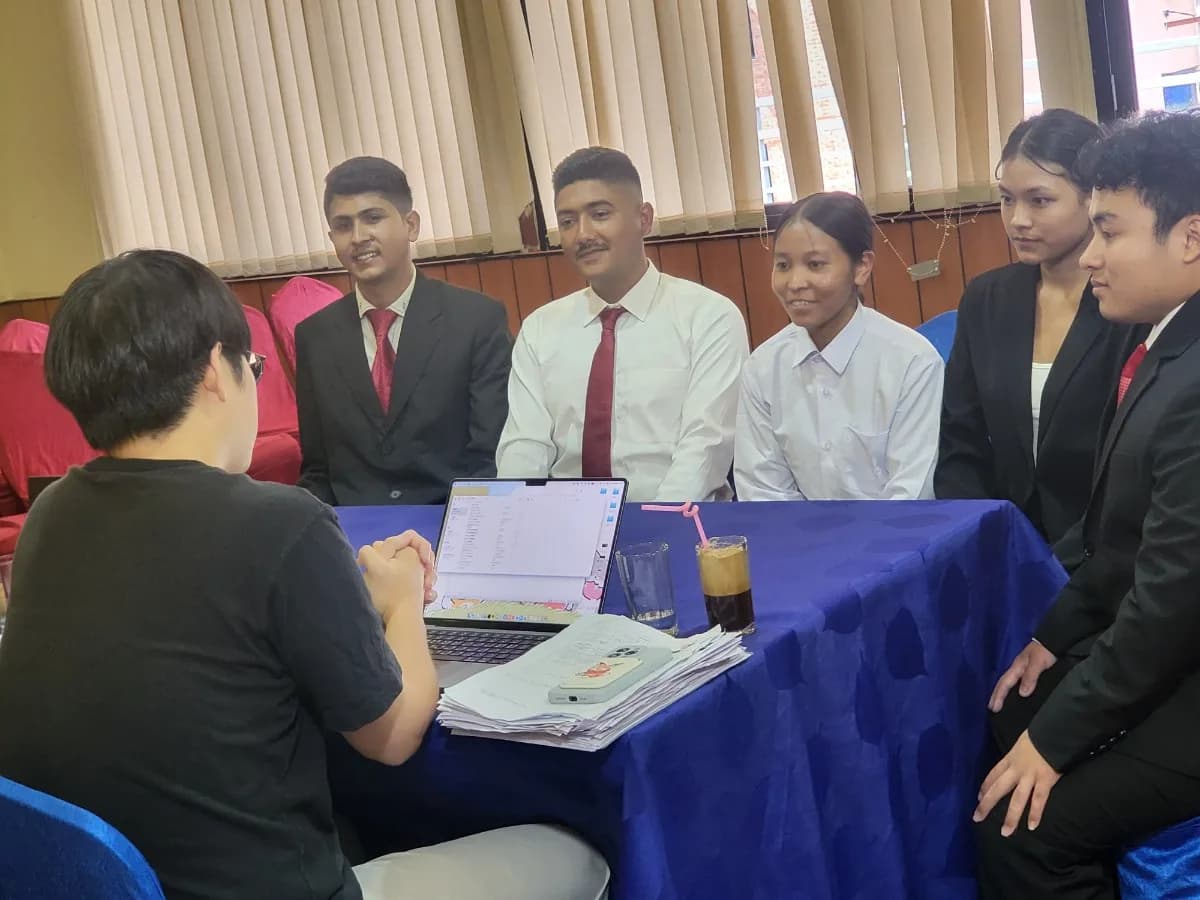
Jeongwoo Human Resource Development Institute applies exactly these criteria when selecting students. Instead of questions with settled answers, we check whether a conversation can be sustained from the candidate's own experience, and we verify in person that the candidate can explain what their resume says.
We give priority to applicants who hold experience in the same industry and prepared their language and skills qualifications on the back of it, and we confirm and record the items and amounts each candidate pays before arrival. Only then do we introduce and place people against the employer's actual role and site conditions.
Frequently asked questions
What should I ask first when interview time is short?
Pick one entry from the resume and ask about it. A single question of that kind tests document accuracy and communication ability at the same time.
Should candidates without experience be ruled out?
No. Same-industry experience is a reason to look more closely, not an eligibility requirement. Where experience is absent, build out pre-departure training and post-placement support instead. Base requirements are set out in the Specified Skilled Worker (i) guide.
Official sources
Key facts were cross-checked against the following primary sources.
- Immigration Services Agency of Japan - Points to note on employment
Official guidance on the ban on deposits and penalty contracts and on who bears support costs.
- Immigration Services Agency of Japan - Specified Skilled Worker Q&A
Official Q&A covering the scope of chargeable support costs and pre-departure guidance duties.